Hyangiram, the Hermitage That Faces the Sun
Hey, it's Sudal. Today I want to talk about a place every Yeosu local has heard the name of at least once: Hyangiram. You know how people flock there before dawn every New Year's? But honestly, not that many people actually know why it's called Hyangiram, or what the name even means. I used to just think of it as the name of a famous temple and move on, but it turns out there's a pretty good story hiding inside that name. Let me walk you through it, piece by piece. You might think, why make such a big deal out of a name — but stick with me, it's more interesting than you'd expect.
A Hermitage at the Tip of Mt. Geumo
Hyangiram is a small hermitage perched on Mt. Geumo, at the very tip of Dolsan Island in Yeosu. Dolsan Island is the island you reach once you cross the bridge — that one. Right at the island's far end, facing the sea, sits Hyangiram. Doesn't the location alone give off a special kind of energy? A hermitage perched at the edge of a mountain ridge, right where it meets the sea — even without knowing the name, that alone makes you curious. When I first learned exactly where it sat, I remember thinking, of course a hermitage belongs right there. There's something meaningful about a spot at land's very edge, facing the open sea, don't you think? If you climb the mountain path, at some point the view suddenly opens up and the sea spreads out in front of you — and honestly, you really have to experience that moment yourself to get the feeling. But once I knew exactly where it sat, I got curious about why it's named Hyangiram in the first place. Written in hanja, the name combines '向' (to face) and '日' (sun) — so it's interpreted as meaning 'facing the sun.' Isn't it kind of amazing that a single name can carry such a big meaning? It makes you feel like you understand, just a little, why the hermitage sits exactly where it does. A hermitage that faces both the sea and the sun — a name and a location lining up this perfectly isn't all that common.
A hermitage standing to face the sun greets Yeosu's morning first.
— 🦦 SudalOne of Korea's Leading Coastal Gwaneum Prayer Sites
Hyangiram is said to be counted among Korea's leading coastal Gwaneum prayer sites. 'Gwaneum prayer site' might sound unfamiliar, but simply put, it's a place where people come to pray to Gwaneum Bosal, the Bodhisattva of Compassion. And among these kinds of sites, Hyangiram is sometimes grouped together with other well-known Gwaneum sacred sites, from what I hear. Of course, this is just worth knowing as 'it's sometimes counted that way' — I can't say for certain exactly how far that grouping goes or by what standard. Still, just being spoken of at that level tells you how meaningful a place this is. Apparently the feeling this hermitage gives is something special, whether you're there to pray or just to look around. Honestly, looking out over the sea from up there, I felt like making a wish of my own — that's the kind of place it is.
The Story of a Changed Name
Now that we've laid all that out, it makes a bit more sense why Hyangiram comes up in conversation so often, right? But honestly, the part I'm most curious about is something else — the story of how it got its current name. The more I looked into this part, the more interesting I found it. Hyangiram apparently wasn't called by this name from the very start. The story goes that it was originally known by a different name, and only later was it changed to the name it carries today. That said, exactly when this happened, or who was behind it, is hard to pin down with certainty. So this part is best understood simply as 'that's the story that's been passed down.' Honestly, hearing this story only made me more curious, but I have to be careful about claiming an exact timing or who exactly changed it. Maybe that's exactly why it stays with you longer as a story. Even without a record to nail it down precisely, the fact that a story like this has been passed down at all says something about how much time this hermitage has seen. If anything, it's the stories that don't quite tie up neatly that tend to stick with me the longest.
Why Crowds Gather Every New Year
There's a particular season when Hyangiram gets especially busy: New Year's. Hyangiram is known as a spot for watching the New Year's sunrise, so when the year turns, a steady stream of people comes to catch that sunrise. Given that the name itself means 'facing the sun,' coming here to watch the first sunrise of the year feels like a perfect match, don't you think? The name, the scenery, and the footsteps of all those people — everything comes together in this one place, and that, to me, is what Hyangiram is all about. The fact that so many people head toward one spot every single New Year is itself proof that Hyangiram is living up to its name. There's something about wanting to greet the year's first sunrise from the very spot that faces it, even after the trouble of climbing a mountain path in the pitch-dark before dawn — I think I get it. Someday I'd like to make that same dark, early climb myself, and stand there among everyone else to greet the first sunrise together.
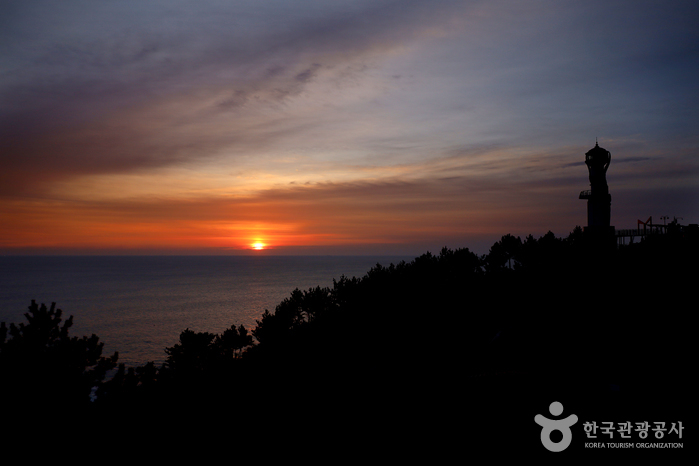
SOODAL's Tip · Once you know what Hyangiram's name actually means, the same view might feel completely different. Even if it's not New Year's, I'd recommend stopping by at least once to feel that spot for yourself.